 Industry InsightsHow to Set Diameter and Weld Quality on a Ring Making & Butt-Welding Combo MachineAn integrated ring-making and resistance butt-we…

Wire Ring Former & Butt Welder Combo: Key Operating Precautions
Industry Insights
Author:
leaf
Time:
3 月 12, 2026
A wire ring-forming and butt-welding all-in-one machine combines coiling and butt joining in one process, greatly raising productivity in hardware fabrication, rebar work, ironwork, and related fields. Because two systems are integrated, poor operation easily causes problems—wrong ring diameter, weak welds, or even safety incidents. This article covers four areas you must remember: safe operation, setup essentials, usage rules, and daily maintenance.

1. Safety First: Installation Rules and Personal Protection
These machines combine hydraulic, electrical, and welding systems—safety comes first.
Installation: place the butt welder indoors with reliable grounding or neutral protection. If several welders sit side by side, keep at least 3 meters between units and connect them to different supply phases. Each welder must have its own knife switch, and conductors between switch and welder should be sleeve-protected.
Operator protection: wear safety glasses and gloves; stand on wood boards or other insulating material. Build the work area with fire-resistant materials and keep firefighting gear ready; never stack flammable or explosive items near the welder.
Equipment must be assigned to trained, certified personnel. Operators must not leave the machine unattended for long distances; stop the machine for coil loading, threading, and lead cut-off. Do not thread rebar until straightening dies are locked and guards are closed—flying dies can injure people after start-up. Never adjust drums while running, never operate with gloves during certain mechanical tasks as prohibited, and never perform maintenance while the machine is running.
2. Setup Essentials: Precise Match of Forming Rollers and Cutter
Proper adjustment before production is required for smooth, efficient work.
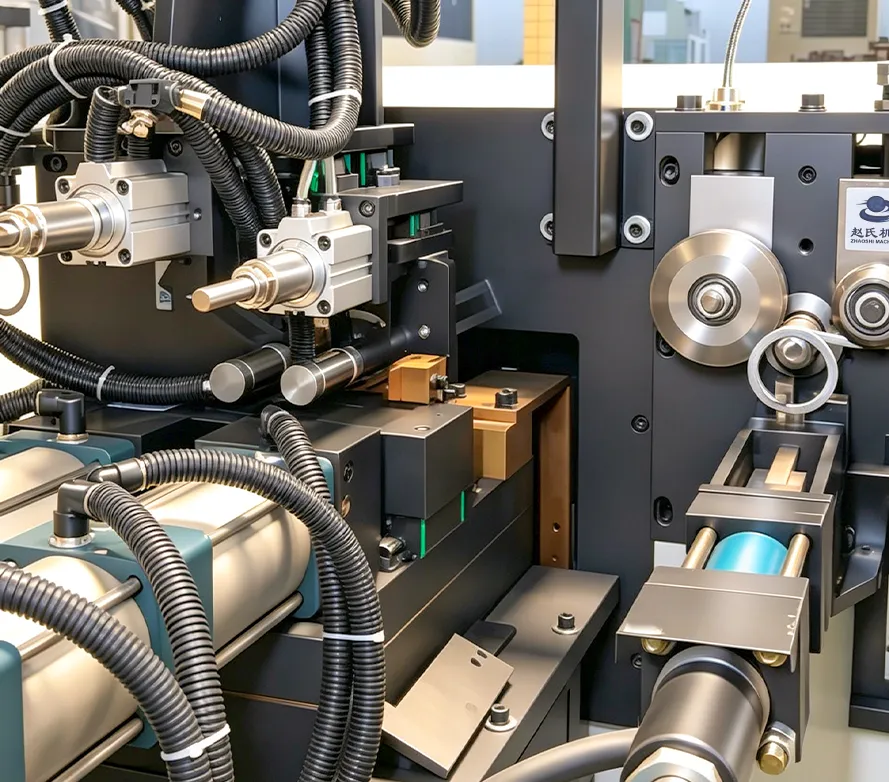
Step one — forming rollers: follow the control-cabinet procedure and feed wire to the cutter zone. Adjust roller position (in/out in the vertical plane) so the product arc meets requirements and flatness is correct. If the product wanders inward/outward, adjust the straightening rollers on the straightener plate to increase straightening force—often caused by poor wire quality.
Step two — cutter: set cutter position so its axis passes through the product center. Misalignment produces an uneven ring mouth.
Step three — trial run: verify production stability and part acceptance. If wire runs off during trials, keep adjusting straightener rollers for more straightening force.
3. Usage Rules: Welding Parameters and Operating Details
Welding parameters: keep cooling water flowing; water temperature must not exceed 40°C. Before welding, set voltage twice according to the rebar cross-section; never weld rebar larger than the machine rating. Hydraulic oil working temperature must not exceed 80°C and should generally stay within 35–70°C.
Weld preparation: clean rust, oil, and dirt within 120 mm of the bar ends. Straighten or cut off bent ends. Ensure solenoid valves work normally; supply voltage fluctuation should stay within +5% to −15% of rated voltage.
Operating details: support long bars on stands with helpers. Watch for flash burns and hot joints. Move bars with coordinated force to avoid impact injuries. Stack finished bars neatly away from flammables. During straightening, if bar jumps the guide trough, fails to reach the length stop, tangles, or leaves the rack, press the limit switch at once, stop cut-off, and resume only after correction. Near the end of a coil or when straightening short bars, hold a protective sleeve and guide the bar to the straightener and drum so it cannot whip freely and injure people.
4. Daily Maintenance: Regular Checks and Timely Service
Electrical: polish breaker contacts with sandpaper every 2–3 days. File electrode (copper) faces regularly. Retighten all secondary-circuit bolts periodically to avoid overheating. Keep cabinet, boxes, and console doors/covers closed to reduce contamination.
Hydraulic: use the oil grade specified in the manual; filter oil before filling. Sample oil quality regularly and replace when it no longer meets requirements. Check and retighten fittings and flanges often. Replace high-pressure hoses on schedule. Replace seals typically every 1.5–2 years. Periodically test or replace major components under a planned maintenance system.
Fault handling: if the hydraulic system shows unstable or low pressure, vibration, or similar issues, diagnose and fix promptly—do not force continued running. Never operate or adjust pressure with a defective gauge or without a pressure gauge.
Related articles
View allIndustry InsightsHow to Set Diameter and Weld Quality on a Ring Making & Butt-Welding Combo MachineAn integrated ring-making and resistance butt-we…Industry InsightsHow to Straighten Wire Fast on a CNC Wire Bender: Shop-Proven Setup That Saves ScrapCNC wire benders deliver high accuracy and speed…Industry InsightsHow to Learn a 3D Wire Forming Machine: Beginner Path from Hardware to Solo ProgrammingA 3D wire forming machine (also called a 3D wire…Related news

Foshan Zhaoshi designs and builds CNC wire forming and resistance-welding equipment — from ring makers and 2D/3D benders to flange lines and turnkey cells. 5000㎡ Shunde workshop · 20+ years · engineer-led support.
Mobile/WhatsApp
Address
No. 5, Xiashi Section, Yangda Road, Xiashi Village, Lunjiao Sub-district, Shunde District, Foshan City, Guangdong Province, China
Mon–Sat 08:00–18:00 (GMT+8)
Follow Us
Copyright © 2026 Foshan Zhaoshi Precision Electromechanical Co., Ltd. All rights reserved.
business license