 Industry InsightsHow to Set Diameter and Weld Quality on a Ring Making & Butt-Welding Combo MachineAn integrated ring-making and resistance butt-we…

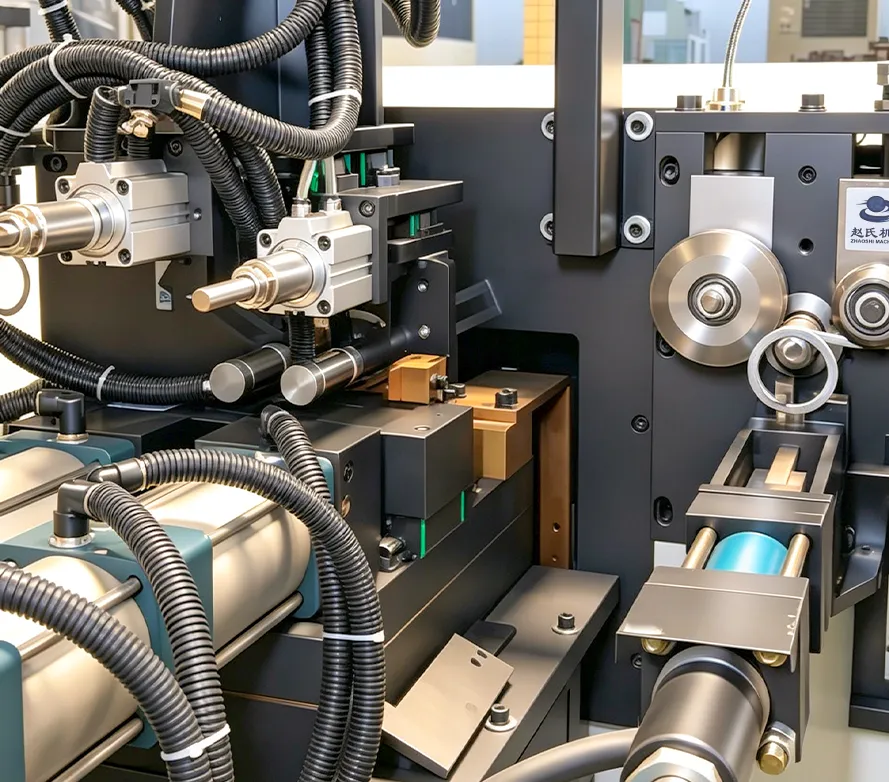
4-Axis Servo Wire Bender: Common Faults and Maintenance Tips
Industry Insights
Author:
leaf
Time:
3 月 12, 2026
Four-axis servo wire bending machines deliver high precision and efficiency in wire forming. Even precision equipment can fail, and scheduled maintenance is the key to longer service life and stable product quality. This article covers the most common issues and a practical maintenance plan to keep your machine at peak performance.

1. Common Problems and Quick Fixes
In daily production, operators most often face issues with bending accuracy, feed stability, and mechanical noise.
First is inaccurate bend angles: the set angle differs largely from the finished part, or angles drift during continuous runs. Causes usually include excessive mechanical backlash, worn tooling, or material springback. Fixes include checking reducer clearance and adjusting compensation parameters, replacing worn bending dies, and enabling angle compensation in the program when material hardness changes.
Second is unstable feed length, which causes out-of-tolerance dimensions. Root causes are often worn or slipping feed rollers, insufficient clamping force, or oil on the wire surface. Inspect feed roller wear regularly, adjust the wire-press cylinder pressure, keep the wire clean, and replace feed rollers when needed.
Mechanical noise or vibration from the bending arm also matters. It may indicate damaged bearings, poor lubrication, or loose fasteners. Stop the machine immediately when unusual noise appears, replace damaged bearings, tighten all connections, check gearbox oil level, and never overload the machine.
Finally, servo drive alarms (overload, overcurrent, and similar) are often linked to mechanical binding, incorrect parameters, or poor cable contact. When an alarm occurs, consult the manual first, check for mechanical jams, inspect cable connectors, and adjust servo acceleration/deceleration times as appropriate.
2. A Practical Maintenance Schedule
Prevention beats repair. A structured maintenance routine sharply reduces downtime. Split work into daily, weekly, monthly, and quarterly cycles.
Daily care (operator): clear chips from the table and dies, check that feed rollers and dies are secure, lubricate sliding guideways, and run the machine empty to listen for abnormal sounds.
Weekly care goes deeper: check and tighten bolts at all points, blow dust from the electrical cabinet with an air gun, confirm cooling fans run correctly, and check gearbox oil level.
Monthly care focuses on wear parts: inspect feed rollers, cut-off knives, and bending dies; replace parts with deep grooves promptly; also check cables for damage and terminals for looseness.
Every quarter or half year, perform a full service: change gear oil after the first three months of use, then every six to twelve months; clean dust from servo motor surfaces; and use gauges to calibrate bend-arm angle and feed length, recalibrating when needed.
Related articles
View allIndustry InsightsHow to Set Diameter and Weld Quality on a Ring Making & Butt-Welding Combo MachineAn integrated ring-making and resistance butt-we…Industry InsightsHow to Straighten Wire Fast on a CNC Wire Bender: Shop-Proven Setup That Saves ScrapCNC wire benders deliver high accuracy and speed…Industry InsightsHow to Learn a 3D Wire Forming Machine: Beginner Path from Hardware to Solo ProgrammingA 3D wire forming machine (also called a 3D wire…Related news

Foshan Zhaoshi designs and builds CNC wire forming and resistance-welding equipment — from ring makers and 2D/3D benders to flange lines and turnkey cells. 5000㎡ Shunde workshop · 20+ years · engineer-led support.
Mobile/WhatsApp
Address
No. 5, Xiashi Section, Yangda Road, Xiashi Village, Lunjiao Sub-district, Shunde District, Foshan City, Guangdong Province, China
Mon–Sat 08:00–18:00 (GMT+8)
Follow Us
Copyright © 2026 Foshan Zhaoshi Precision Electromechanical Co., Ltd. All rights reserved.
business license